Saudi Vision 2030: Progress, Mega-Projects & the Companies Driving Change
Saudi Arabia is rewriting its own story — and the world is watching.
When Saudi Vision 2030 was announced in April 2016, many observers were skeptical. Could a nation so deeply woven into the fabric of the global oil economy genuinely reinvent itself in just 14 years? Nearly a decade later, the answer is becoming increasingly clear: yes — and the transformation is happening faster than most expected.
But here’s what often gets lost in the big-picture headlines: Vision 2030 isn’t just being built by government agencies and billion-dollar sovereign funds. It’s being built by the companies on the ground — the ones delivering the workforce, managing the facilities, and keeping the infrastructure of the new Saudi Arabia running day and night. Companies like Seerah, which has embedded itself into Vision 2030 through critical manpower services and facility management solutions across the Kingdom, from Riyadh to Jeddah and beyond.
This article is your comprehensive guide to understanding Vision 2030 Saudi Arabia — its pillars, its progress, its mega-projects, and the role that specialized service companies play in making it all work.
What Is Saudi Vision 2030?
Saudi Vision 2030 is the Kingdom of Saudi Arabia’s national transformation strategy, launched on April 25, 2016, under the leadership of Crown Prince Mohammed bin Salman. It is a comprehensive roadmap to reduce the country’s economic dependence on oil, diversify revenue streams, and build a competitive, knowledge-based economy powered by its people.
The vision is structured around three foundational pillars:
| Pillar | Core Focus |
|---|---|
| A Vibrant Society | Quality of life, culture, sports, Islamic values, heritage |
| A Thriving Economy | Private sector growth, investment, job creation, diversification |
| An Ambitious Nation | Governance, transparency, accountability, global rankings |
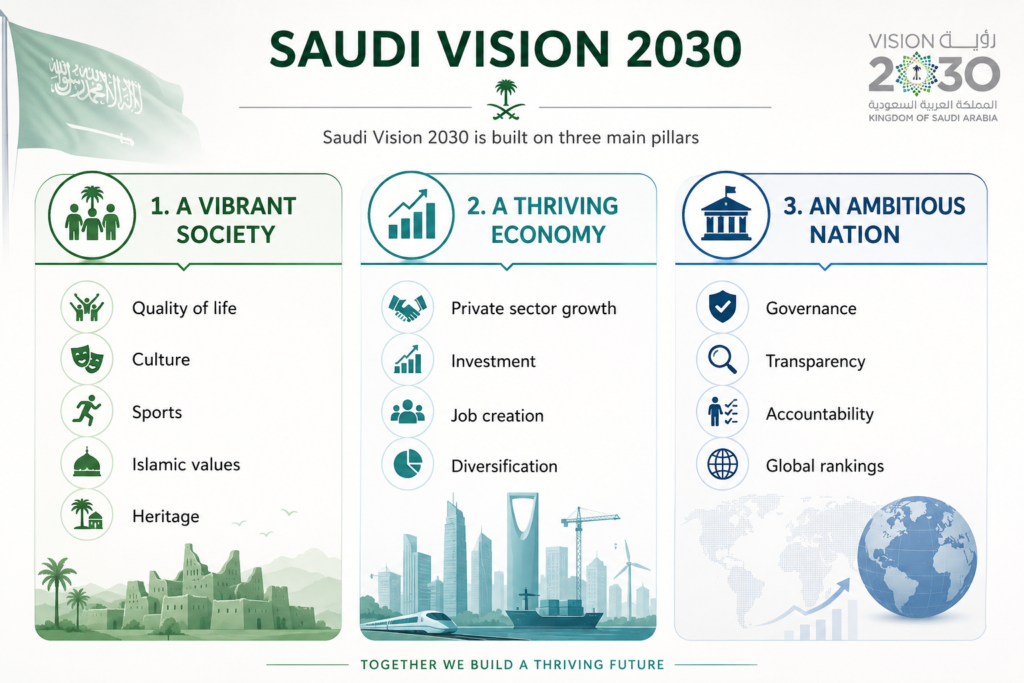
These pillars are not marketing language. Each one drives specific programs, targets, and billions in government and private investment — all tracked against measurable Key Performance Indicators (KPIs) reported publicly by the Vision 2030 delivery office.
Why Saudi Arabia Needed Vision 2030
To appreciate the vision, you need to understand what Saudi Arabia was facing before it.
In 2015, oil accounted for approximately 73% of government revenues. Youth unemployment among Saudi nationals hovered at double digits. The private sector was comparatively small, over-reliant on cheap expatriate labor, and not generating enough quality jobs for a young and growing Saudi population — over 60% of citizens were under 30 years old.
At the same time, global oil prices had crashed. The warning was unmistakable: a country that earns most of its income from a single commodity is deeply vulnerable. Vision 2030 Saudi Arabia was the strategic response — a plan to build an economy diverse enough, and a society dynamic enough, to thrive in any future.
The KSA Vision 2030 agenda covers everything from entertainment and tourism to technology, healthcare, education, and industrial development. But critically, it also demands world-class operational services — workforce solutions, facilities management, logistics, and project support — to bring its ambitions to life on the ground.
The Mega-Projects Defining 2030 Vision Saudi Arabia
Nothing captures the sheer ambition of Saudi Arabia’s 2030 vision like its giga-projects. These are not standard infrastructure developments — they are new cities, new ecosystems, and entirely new economic sectors being created from scratch.
NEOM — A Blueprint for the Cities of Tomorrow
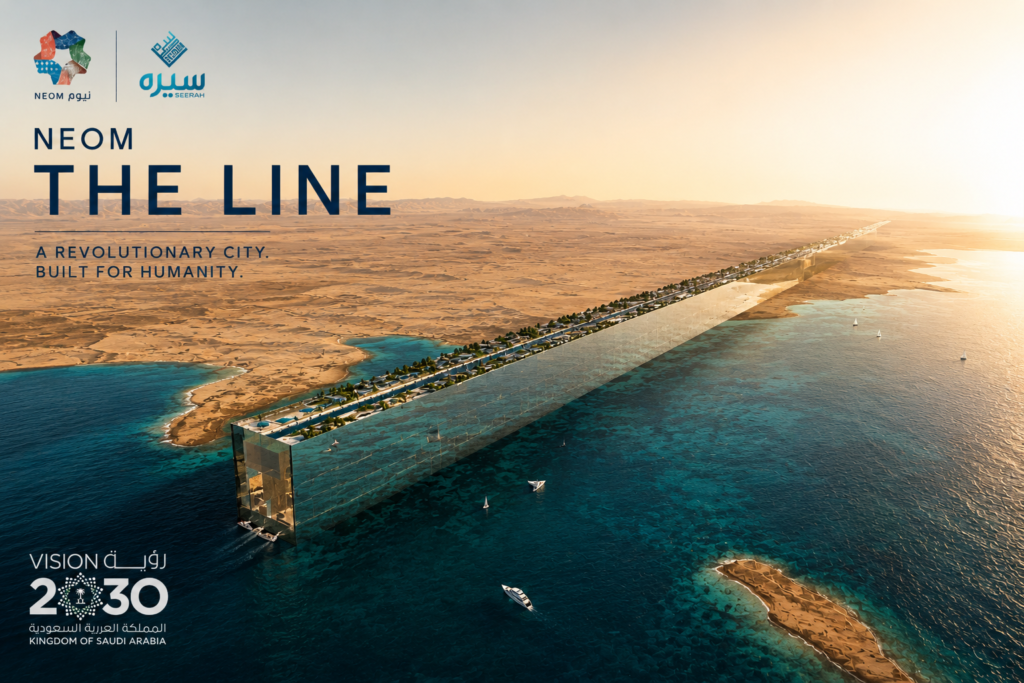
NEOM is the flagship of all Vision 2030 mega-projects. Located in the Tabuk region of northwestern Saudi Arabia, it spans 26,500 km² and houses multiple sub-projects including THE LINE — a 170-km linear city designed for 9 million residents, car-free, powered entirely by renewables. NEOM is not just a real estate project; it’s a global statement about what urban life could look like in 2030 and beyond.
The Red Sea Project & AMAALA
Covering a pristine 28,000 km² archipelago, the Red Sea Global Project is being developed as a luxury, conservation-led tourism destination with a net-zero carbon footprint. AMAALA, its ultra-luxury companion, targets wellness, arts, and cultural tourism. Together, they are Saudi Arabia’s answer to the Maldives, Bali, and Monaco — all in one place.
For a complete overview of what the Red Sea region offers — from the mega-project to beaches, resorts, and Jeddah’s famous Red Sea Mall — Read our full Red Sea Saudi Arabia guide.
Diriyah Gate
Just outside Riyadh, the birthplace of the Saudi state is being transformed into a world-class heritage, cultural, and lifestyle destination. At its heart sits At-Turaif — a UNESCO World Heritage Site. Diriyah will welcome millions of visitors annually, generating over 100,000 direct jobs, and cementing Saudi Arabia’s identity as a destination where ancient heritage and modern ambition coexist.
Qiddiya
Saudi Arabia’s entertainment capital is rising 45km west of Riyadh. Qiddiya will be home to theme parks, motorsport circuits, concert arenas, esports venues, and arts spaces — directly supporting Vision 2030’s goal to increase household entertainment spending from 2.9% to 6% of income.
Each of these projects requires enormous operational infrastructure — from the construction phase through to ongoing facility management, workforce deployment, and maintenance. This is where specialized service providers become indispensable.
Key Vision 2030 Targets: Where Does Saudi Arabia Stand?
Saudi Arabia has set specific, measurable benchmarks. Here’s how progress looks across major indicators:
| Vision 2030 Target | Baseline (2016) | 2030 Goal | Status (2024–25) |
|---|---|---|---|
| Non-oil government revenue | SAR 163 billion | SAR 1 trillion | Strong growth recorded |
| Private sector share of GDP | 40% | 65% | Rising steadily |
| Female workforce participation | 17% | 30% | Exceeded — now 33%+ |
| Saudi unemployment rate | 11.6% | 7% | Approaching target |
| Annual tourism visitors | ~30 million | 150 million | 100M+ reached in 2023 |
| Household entertainment spending | 2.9% | 6% | Increasing significantly |
| PIF assets | $150 billion | $2 trillion | Over $700 billion (2024) |
What these numbers reveal is a transformation that is real, measurable, and accelerating — even if not every target will be met precisely on schedule.
Manpower Services in Saudi Arabia: The Workforce Behind Vision 2030
Here’s something the investment reports don’t emphasize enough: Vision 2030 is a people project.
Giga-projects don’t build themselves. New hospitals, smart cities, resort islands, entertainment venues, and industrial zones all require one thing above everything else — the right people, in the right place, at the right time.
This is where manpower services in Saudi Arabia have become one of the most strategically critical sectors in the entire Vision 2030 ecosystem. Across every major project site — from Tabuk to Riyadh, from Jeddah’s waterfront developments to the Red Sea coast — the demand for skilled, semi-skilled, and specialized labor has surged.
Seerah has positioned itself at the heart of this demand. As a company actively contributing to Vision 2030 project delivery, Seerah provides comprehensive manpower services across Saudi Arabia, supplying vetted, trained, and deployment-ready workforces to mega-projects and enterprises across the Kingdom. Whether it’s construction labor, technical specialists, hospitality staff, or administrative personnel, Seerah’s workforce solutions are designed around the specific operational demands of Vision 2030’s project timelines.
Key manpower services Seerah delivers in Saudi Arabia include:
- Skilled and semi-skilled labor supply for construction and infrastructure projects
- Technical manpower for engineering, MEP, and project management roles
- Hospitality and facility staffing for hotels, resorts, and entertainment venues
- Administrative and professional staffing for corporate and government clients
- Recruitment and onboarding aligned with Saudization (Nitaqat) compliance requirements
For businesses and project developers looking to scale their workforce in line with Vision 2030 timelines, Seerah’s manpower services offer a reliable, compliant, and experienced partner.
Facility Management Services: Keeping Vision 2030 Running
Building something extraordinary is only half the challenge. Keeping it running — efficiently, safely, and sustainably — is the other half.
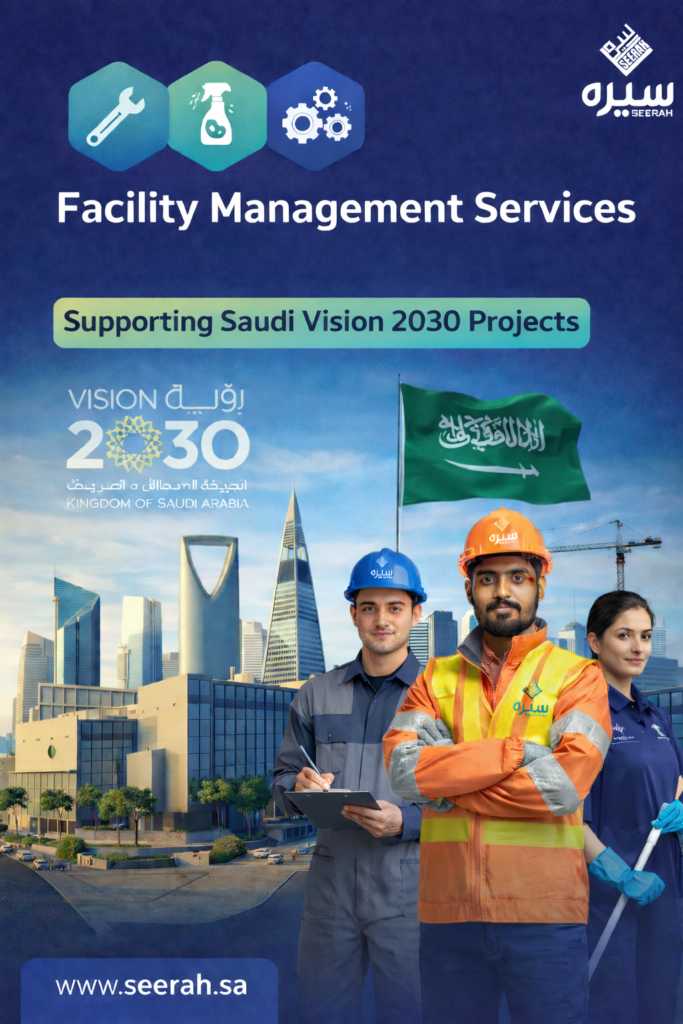
As Vision 2030 brings hundreds of new facilities online — from luxury resorts and cultural centers to hospitals, office towers, smart city infrastructure, and entertainment complexes — facility management services in Saudi Arabia have become a critical sector in their own right.
Facility management encompasses everything from cleaning, maintenance, and security to HVAC systems, waste management, energy efficiency, and compliance. In a country building from scratch at the pace Saudi Arabia is moving, the quality of FM services directly impacts the reputation of Vision 2030 projects in the eyes of both domestic users and international visitors.
Seerah's Facility Management Services Across Saudi Arabia
Seerah delivers professional facility management services across Saudi Arabia, with particular depth of operations in Jeddah and Riyadh — the two cities at the heart of Vision 2030’s economic and social transformation.
In Riyadh, Saudi Arabia’s capital and the epicenter of Vision 2030 activity, Seerah supports corporate campuses, government facilities, mixed-use developments, and hospitality venues with integrated FM solutions. As Riyadh prepares to host the 2034 FIFA World Cup and continues its transformation into a global metropolis, the demand for professional, scalable facility management has never been higher.
In Jeddah — Saudi Arabia’s commercial capital and Red Sea gateway — Seerah’s facility management services support the city’s rapidly expanding infrastructure, including waterfront developments, logistics hubs, hospitality properties, and retail complexes. Jeddah’s role in Vision 2030 as a global port city and tourism destination makes rigorous FM services not just desirable, but essential.
Seerah's facility management offerings include:
- Hard FM Services: Mechanical, electrical, plumbing (MEP) maintenance; HVAC management; fire systems; lifts and escalators
- Soft FM Services: Cleaning, janitorial, pest control, landscaping, waste management
- Integrated FM Solutions: Single-provider management of all facility services under one accountable contract
- Energy Management: Sustainability-focused solutions supporting Vision 2030’s renewable energy and efficiency goals
- Security Services: Access control, CCTV management, and on-site security staffing
- Project-Phase FM: Supporting facilities from construction handover through operational ramp-up
Whether you’re developing a hospitality asset in Jeddah, managing a corporate campus in Riyadh, or operating infrastructure across multiple Vision 2030 project sites, Seerah’s facility management team is built to deliver — at scale, with compliance, and with the reliability that Vision 2030’s ambitions demand.
Seerah: A Saudi Company Built for Vision 2030
What makes Seerah stand out in a market that now has hundreds of companies claiming Vision 2030 alignment?
The answer is specificity and substance. Seerah isn’t a company that pivoted to Vision 2030 language after the fact. Its core services — manpower solutions and facility management — are precisely what Vision 2030’s project pipeline demands at every stage of development and operation.
Seerah operates with a clear understanding that the success of Vision 2030 mega-projects depends on two invisible but essential systems: the workforce that builds and runs them, and the facility management infrastructure that keeps them performing to international standards. Both of these are Seerah’s home ground.
As a company rooted in Saudi Arabia’s values and national ambitions, Seerah also brings a deep understanding of Saudization requirements, local labor regulations, and the cultural and operational nuances that international service providers often overlook. This local expertise, combined with operational scale, makes Seerah a genuinely trusted partner for Vision 2030 contributors.
To learn more about Seerah’s services, Vision 2030 project involvement, and how to engage with the team, visit seerah.sa.
Vision 2030 and Saudi Society: The Human Transformation
Beyond the mega-projects and economic targets, Vision 2030 Saudi Arabia is fundamentally changing daily life in the Kingdom.
Women’s empowerment has been one of the most visible transformations. Female workforce participation has already surpassed the 30% target set for 2030. Women now drive, lead companies, hold ministerial positions, and participate fully in the social and economic life of the nation. This isn’t just a social milestone — it’s an economic multiplier.
Entertainment and culture have been revolutionized. Cinemas, concerts, sports events, and festivals — once rare or unavailable — are now regular features of Saudi life. Formula 1, international boxing, WWE, K-pop, and global music festivals have all found homes in Saudi Arabia. The country is spending billions to build not just physical entertainment infrastructure, but an entire creative economy.
Youth development is central to everything. With over 60% of the population under 30, Vision 2030 KSA has invested heavily in scholarship programs, startup ecosystems, sports academies, digital skills training, and cultural initiatives. The goal is simple: give Saudi youth the tools to build meaningful, productive lives within their own country.
Understanding the deep Islamic identity that grounds Saudi society — even as it modernizes — is essential context for any business or individual engaging with the Kingdom. The Prophetic legacy and values that shape Saudi culture are explored thoughtfully at seerah.sa, offering rich context for those seeking to understand the Kingdom’s social fabric at its roots.
Economic Reforms Powering the KSA Vision 2030 Engine
While giga-projects are visible, it’s the structural economic reforms that will determine Vision 2030’s lasting success.
The Public Investment Fund (PIF)
PIF has grown from a domestic holding company into one of the world’s most active sovereign wealth funds. With over $700 billion in assets and stakes in companies from Lucid Motors to Nintendo, the PIF is both a domestic investor in mega-projects and a global financial player — diversifying Saudi Arabia’s income at a macro level.
VAT introduction and subsidy reform
VAT introduction and subsidy reform were politically difficult but fiscally necessary. VAT was introduced at 5% in 2018 and raised to 15% in 2020. Combined with subsidy rationalization and austerity measures, these reforms have significantly improved Saudi Arabia’s non-oil fiscal position and reduced structural budget vulnerability.
Saudization (Nitaqat)
Saudization (Nitaqat) continues to push private sector employers to increase Saudi national employment. For service companies like Seerah, this means actively developing Saudi talent pipelines — an area where Seerah’s HR infrastructure and training programs provide genuine value to client organizations navigating compliance requirements.
Privatization
Privatization is opening entire sectors — healthcare, education, transport, utilities — to private sector competition and international investment. Saudi Aramco’s 2019 IPO, the largest in history at a $1.7 trillion valuation, was the most dramatic example of this philosophical shift.
FAQ: Saudi Vision 2030 — People Also Ask
1. What is Saudi Vision 2030 in simple terms?
Saudi Vision 2030 is Saudi Arabia’s long-term national strategy, launched in 2016, to reduce dependence on oil by building a diversified economy, improving citizens’ quality of life, and positioning the Kingdom as a global hub for trade, tourism, technology, and culture — while maintaining its Islamic identity and values.
2. What are the main pillars of Vision 2030 Saudi Arabia?
Vision 2030 is built on three pillars:
- A Vibrant Society — wellbeing, culture, sport, and Islamic heritage
- A Thriving Economy — private sector growth, diversification, and investment
- An Ambitious Nation — effective governance, transparency, and global competitiveness
3. Which companies are working on Vision 2030 projects in Saudi Arabia?
Both global and Saudi-based companies are involved across sectors. In manpower and facility management, Seerah is among the companies actively supporting Vision 2030 mega-projects across Saudi Arabia, delivering workforce solutions and integrated FM services in Riyadh, Jeddah, and other key cities.
4. What are facility management services in Saudi Arabia?
Facility management (FM) services in Saudi Arabia cover the full range of services needed to operate and maintain built environments — including cleaning, maintenance, HVAC, security, energy management, and landscaping. As Vision 2030 brings hundreds of new facilities online, professional FM services like those offered by Seerah have become essential to keeping them running at international standards.
5. What is Saudization and how does it affect businesses in KSA?
Saudization (also called Nitaqat) is the Saudi government’s policy requiring businesses to employ a minimum percentage of Saudi nationals. The targets vary by sector and company size. Compliant companies receive better classification and access to government services, while non-compliant companies face restrictions. Manpower providers like Seerah help businesses navigate these requirements through compliant recruitment and workforce management.
6. What is NEOM and why is it important for Vision 2030?
NEOM is Saudi Arabia’s most ambitious giga-project — a futuristic city complex in the Tabuk region spanning 26,500 km². Its flagship component, THE LINE, is a 170km linear city designed for 9 million people with zero cars and 100% renewable energy. NEOM represents Vision 2030’s boldest bet: that Saudi Arabia can build the city of the future from the ground up, attracting global talent, investment, and innovation.
7. How can businesses provide services to Vision 2030 mega-projects?
To work with Vision 2030 projects, businesses typically need to be registered with relevant Saudi authorities (MISA, MOMRA, or sector-specific bodies), meet Saudization compliance targets, and demonstrate relevant experience and certifications. For manpower or FM services specifically, partnering with an established local provider like Seerah can significantly accelerate market entry and compliance.